
Home/Company
COThe outfit
Colorado is our territory and shower trailers are our trade
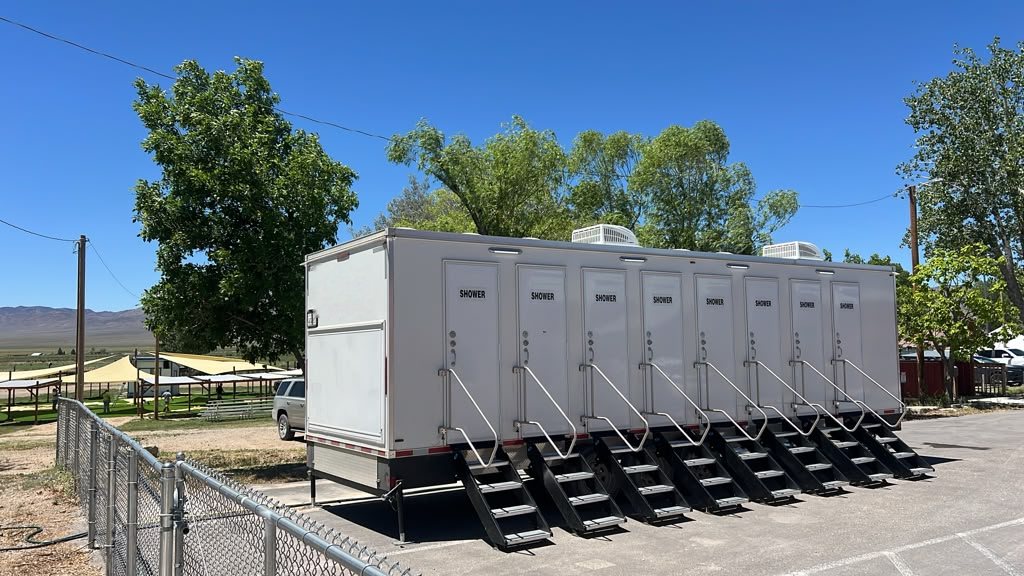
An independent, licensed and insured rental company that puts private hot showers on Colorado job sites, camps, event grounds and facilities, and services them for as long as they stay.
Certificates of insurance on request.
Any town, quoted with a haul time.
Quotes and bookings on the call.
Two stall and accessible layouts too. Compare the trailers
COCrew notes
Reviews from crews on long Colorado shower trailer placements
Rated 5 out of 5
The same two drivers set the unit and serviced it for five months on our Firestone subdivision. By week two they knew the gate code, the pad and my foreman by name.
Rated 5 out of 5
The certificate with our additional insured wording came back the same afternoon.
Rated 4 out of 5
They told me on the first call that my week was already committed and offered the Monday after. That straight answer is why I called them again in the spring.
AScope
What we do and what we leave alone
We rent shower trailers. That is the business, start to finish. We bring the unit, level it, connect it to whatever the site has, test every stall, and come back on a schedule to clean, pump and restock it until the job is over. We do not run a general equipment yard with showers as a sideline, and we do not broker somebody else's trailer and hope it shows up. The crews who set our trailers are the same crews who service them.
Staying narrow is a choice. A shower trailer is a small plumbing and mechanical system towed into places that are hard on plumbing and mechanical systems. Sub zero nights, thin air, rough gravel, dust that gets into everything and a delivery window that closes when the pass does. Doing one thing well in those conditions takes more attention than doing five things adequately, so we stopped at one.
If you need something we do not carry, we will say so on the phone and get out of your way. What we will not do is talk you into a unit that does not fit your site so we can book the week.
The work splits into four rough shapes and we handle all of them. Long placements for working crews, where the unit lives on a site for weeks or months and the service rhythm matters more than anything else. Short, sharp event work, where a violent peak and a venue full of people make placement the hard problem. Incident and recovery work, which starts before the paperwork and runs on somebody else's command structure. And facility work, where a building's own hot water is offline and people still have to get clean in the meantime.
CORenting
How renting one works
- Step 01
Start with the site
Where it is and when you need it, then how many people wash at the end of a shift. - Step 02
Get the quote
It names the unit and the service plan, with the assumptions written next to them. - Step 03
Paperwork and pad first
Vendor forms and insurance certificates cleared, and a firm spot the service truck can reach. - Step 04
Set, tested, serviced
The unit is leveled and tested stall by stall, then serviced on the agreed rhythm until pickup.
BGround truth
Why Colorado needs its own approach
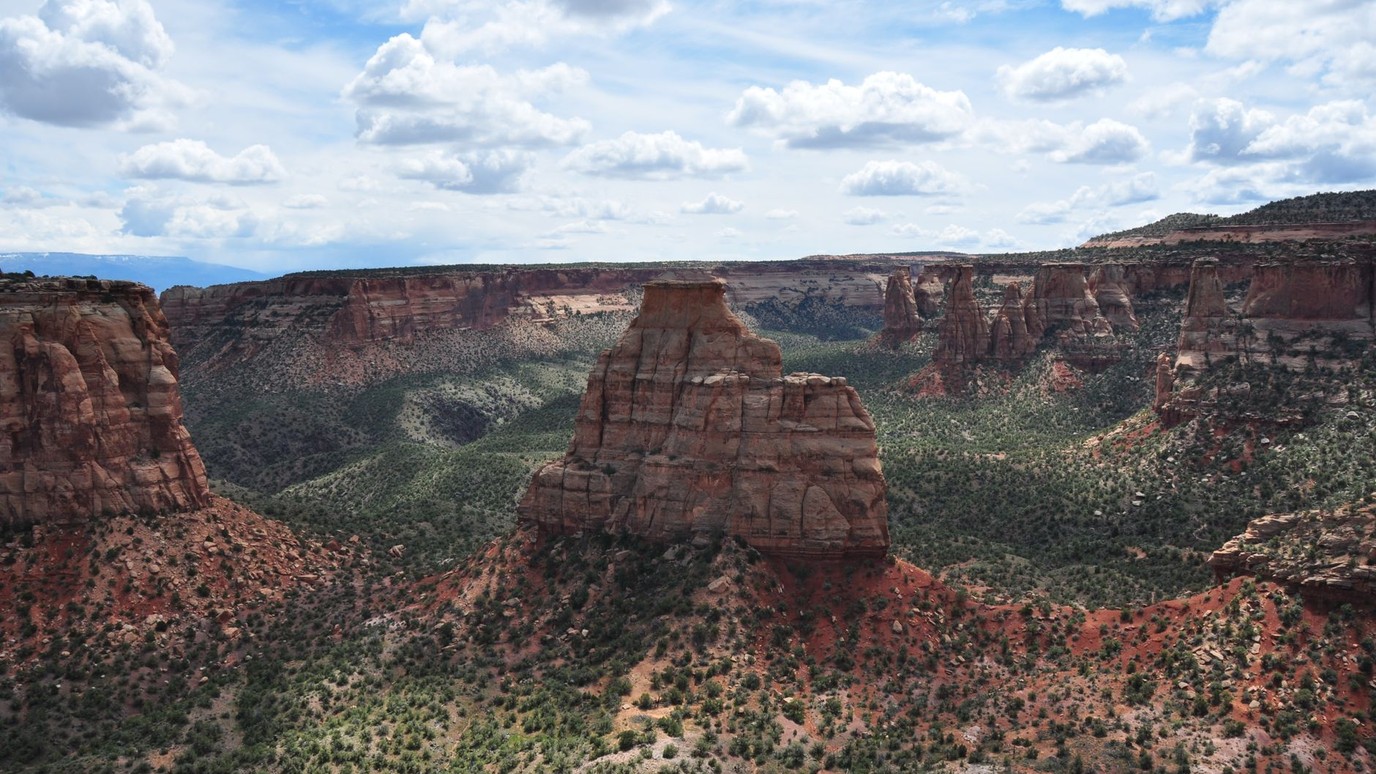
A shower trailer that works fine at sea level in a mild climate is not automatically ready for a pad at eight thousand feet in January. Elevation makes the air thin, and thinner air changes how burners and generators perform. Winter here is not a few cold weeks, it is months of freeze and thaw cycles that find every unprotected line and fitting. Spring turns firm ground into soft ground in an afternoon. Summer brings afternoon storms in the high country and heat on the plains. Fire season now runs most of the year.
We plan for those conditions before a trailer leaves, not after it fails on your site. Heat trace and insulation on the water path, interior heat that stays on overnight, generators sized for the elevation of the actual pad, skirting where the wind gets underneath, and a delivery schedule that respects chain laws and pass closures. None of that is exotic. It is just the difference between a unit that runs all winter and one that is frozen solid by the second morning.
The other Colorado reality is distance. A run from Denver to a pad outside Cortez is roughly seven hours of driving, and a lot of the work sits at the end of a county road like that one. We quote drive time honestly, and we tell you when a site needs a look at the approach before we commit a truck and trailer to it.
It is also five or six different operating environments rather than one. The Front Range corridor is flat to rolling, mostly paved, and holds the bulk of the state's construction volume, so the usual question there is access rather than survival. The high country above seven and a half thousand feet is where altitude, cold and road closures converge hardest. The Western Slope and the Grand Valley run hot and dry in summer with real wind and long distances between towns. The San Juans in the southwest add narrow mountain access, falling rock, avalanche danger that the Colorado Avalanche Information Center forecasts through winter and spring, and flash flooding in the monsoon months. The eastern plains are wide, windy and far apart, which makes water hauling and service response the limiting factors rather than terrain.
Nothing about that is exotic once you have worked in it for a while. It just means the right answer changes with the address, and a company that treats the whole state as one operating picture will eventually get caught out by the part of it that does not match.
CThe operating year
How each Colorado season changes shower trailer work
Our year has a shape, and knowing it is most of what makes a schedule realistic. Winter is the hard one and it runs long. From late autumn into spring the high country is below zero at night often enough that freeze protection stops being a feature and becomes the whole job, and the mountain corridor closes repeatedly for storms, avalanche control and accidents. Deliveries in that window carry schedule buffer as a matter of course, because a corridor that shuts for six hours does not care what was on the board.
Spring is the season people underestimate. As the frost comes out of the ground, dirt roads and raw pads on the Western Slope and in the mountain valleys turn soft, and ground that carried a loaded truck in February will not carry it in April. Mud season limits heavy vehicle access as effectively as snow does and it arrives without a storm to announce it, so from roughly March into May the pad conversation gets more attention than the weather forecast does.
Summer splits in two. On the plains and in the Grand Valley it is heat, sun and wind, which is a cooling and a water problem rather than an access one. In the high country and the southwest it is the monsoon, with clear mornings giving way to afternoon lightning, heavy rain and genuine flash flood risk on dirt roads and low crossings, worst below slopes that burned in a previous year. Summer is also when the event calendar is at its heaviest, so it is the season where availability rather than conditions is usually the binding constraint.
Fire season no longer has a tidy start and end. In a dry year with thin snowpack it can run most of the year, and it can take units and crews out of the commercial schedule with no notice when an incident stands up a base camp. We plan for that rather than pretending it will not happen, which is part of why we are direct about availability during dry stretches instead of promising units we may need to move.
DBetween jobs
What happens to a unit between two jobs
A trailer that comes back off a job does not go straight out on the next one. It gets stripped and cleaned properly, tanks flushed, stalls and vanity washed down rather than wiped over, and then it gets looked at by somebody whose job on that day is finding problems. Fixtures, door locks and seals, steps and hand rails, lighting, heaters, pumps, the heat trace and its insulation, the tires and the running gear, the jacks and the leveling equipment.
Most of what gets caught in the yard is small and would have become large on a pad two hundred miles away. A latch that has started to drop. A drain running slower than it should. A heat trace lead rubbed raw where somebody dragged a hose across it. A tire that will pass a glance and will not pass a winter haul over a pass. Fixing those in a lit shop with the parts on the shelf takes an hour. Fixing them on the fourth day of a placement at the end of a county road takes a truck, a driver and most of a day.
Supplies get made up in the yard too, so a service visit is restocking from a stocked truck rather than discovering halfway through a run that the truck is short. It is dull work and it is most of the reason a unit behaves itself once it is on your site.
Winter adds a step. Anything heading into cold country gets its freeze protection verified rather than assumed: heat trace continuity checked, insulation intact, tank heaters cycling at the right thresholds, skirting on the truck. A unit that leaves the yard in November with a heat trace fault is a unit that fails on the first hard night, and by then it is a recovery job rather than a repair.
EThe board
Scheduling, and who actually does it
Dispatch is the middle of everything here, and it is a person rather than a system. When a request lands, whoever takes it works out what the job actually needs, checks what is committed against what is free, and puts it on the board with the haul time built in rather than bolted on afterwards. That is why the person answering the phone can usually tell you on the same call whether a week is real.
The board is built around drive time, not around distance. Colorado is wide and the roads between its corners are long, and an address that looks close on a map can be on the far side of a pass that adds hours in the wrong season. A Front Range delivery and a southwest corner delivery are different animals even when the mileage is not that different, and pretending otherwise is how a driver ends up chasing a window that was never achievable.
Seasonal load is real and we are straightforward about it. From early summer into the autumn the arenas, fairgrounds and river towns all want the same handful of weekends, and a fire season can take units and crews out of the schedule with no notice at all. When that squeezes availability, the first thing you hear is the constraint rather than a soft yes that falls apart later in the week.
Changes get handled the same way. Dates slip, crews grow, a pad turns out to be somewhere else than the pin said. Tell dispatch and the board gets reworked. What does not work is discovering the change when the driver arrives, because at that point the only flexibility left is whatever happens to be on the truck.
FDrivers
The person who sets the unit is the person who services it
The crews who set our trailers are the crews who come back to service them. That is deliberate. A driver who set a unit knows how it sits, which corner took the cribbing, where the generator ended up, which gate is the one that is actually open at six in the morning, and which part of the approach turns to grease after rain. None of that survives a handoff to a stranger with a work order.
On site our drivers work to your rules rather than ours. Badging, orientation, gate hours, staging areas, escort or spotter requirements, radio channels, whatever the job runs on. We would rather spend the extra half hour doing it your way than create a problem for a superintendent who already has enough to manage. On an incident that means working through the logistics section and the camp manager rather than looking for a commercial point of contact who does not exist.
Winter driving is part of the job description rather than a hazard we react to. The Colorado traction law on the mountain corridor runs from early autumn to late spring and requires real tread and either winter rated tires or chains, with tighter rules and enforcement for commercial vehicles. Our drivers carry chains, know how to fit them before they are standing in a storm, and treat a chain up as a normal part of a winter run rather than a last resort.
The other half of the driver's job is what they leave behind. On a February set near Fairplay, that means ten minutes at the unit with the site contact, spent mostly on keeping the generator running through a night that can drop below zero. A unit that is set correctly and explained badly still fails in the second week.
GBoth directions
Water in and waste out, across long distances
Setting a trailer is the short part. Keeping it running for weeks in a place with no water and no sewer means two supply chains that have to work every time, and on a state this wide they are the part that takes planning rather than the trailer.
Waste goes out through licensed haulers to approved treatment facilities, normally documented with a manifest for the load. On the Front Range that is straightforward, because the distances are short and the receiving sites are close. On the Western Slope, in the San Juans and out on the eastern plains it is a real logistics problem: the round trip from a remote pad to an approved facility and back can consume most of a working day, which means the service cadence has to be built around the haul rather than around a tidy weekly rhythm.
Water works the same way in reverse. Where a site has an approved potable connection the question disappears. Where it does not, potable water gets hauled to the pad on a schedule, and that schedule is set against real consumption rather than an opening estimate. On long remote placements the refill run is planned from day one instead of being arranged in a hurry when the tank gets low.
Both chains are why we ask about duration and headcount before we talk about equipment. A weekend job for a small crew is a fill and go. A multi week placement for a full crew at the end of a county road is a recurring schedule with somebody named against each leg of it, and it is far cheaper to design that at the start than to retrofit it in week three.
HWhere we draw the line
The work we turn down
A shower trailer is often the one place on a job or in a camp where somebody gets a few private minutes to themselves, and that sets the standard for everything else. Units go out clean and they are returned to clean on every service visit. Doors latch. Water is hot. Lights work. There is soap at the vanity. If something is off, the person using it should not be the one who notices first.
There is a short list of things we decline. We will not put a unit on ground that will not hold it, because a trailer that settles or shifts is a safety problem before it is a service problem. We will not promise a delivery window through a corridor that is closing, because an honest window beats a promised hour every time. We will not send a unit into a winter placement without full freeze protection on the theory that the forecast looks mild. And we will not talk you into a bigger unit than the shift pattern justifies in order to book the week.
We also say no to work that is not ours. If you need something we do not carry, you will hear that on the phone rather than after a week of being managed toward a compromise. There is no version of this business where pretending otherwise ends well for either side.
The last standard is about information. You get the constraints plainly and early, including the ones that are inconvenient for us. If the only unit that carries your headcount is committed until the middle of the month, that is the first sentence of the conversation rather than something you find out after building a schedule around it.
The same applies when something goes wrong on our side, because occasionally it does. A truck breaks, a corridor shuts, a pad turns out to be unusable when the driver gets eyes on it. In every one of those cases you hear what happened and what we are doing about it while there is still time to work with the information, rather than an apology afterwards that explains a day you have already lost.
ILifecycle
How a rental actually runs
It starts with a conversation about the site rather than about the equipment. Where it is, when you need it, how many people and how they rotate, what the pad is made of, and what if anything is available in the way of water, power and waste. From those answers the unit, the stall count and the logistics plan fall out together, and you get a quote with the assumptions written next to it so you can see which parts move if the scope does.
Before delivery day, the paperwork gets cleared and the approach gets settled. Vendor registration, insurance certificates naming the right parties, safety orientation, a written service plan if your organization wants one. In parallel the pad question gets closed out, which on a lot of jobs means somebody confirming that the spot is firm, level enough, clear of overhead lines and drainage, and reachable by a truck towing a long unit that has to turn around again afterwards.
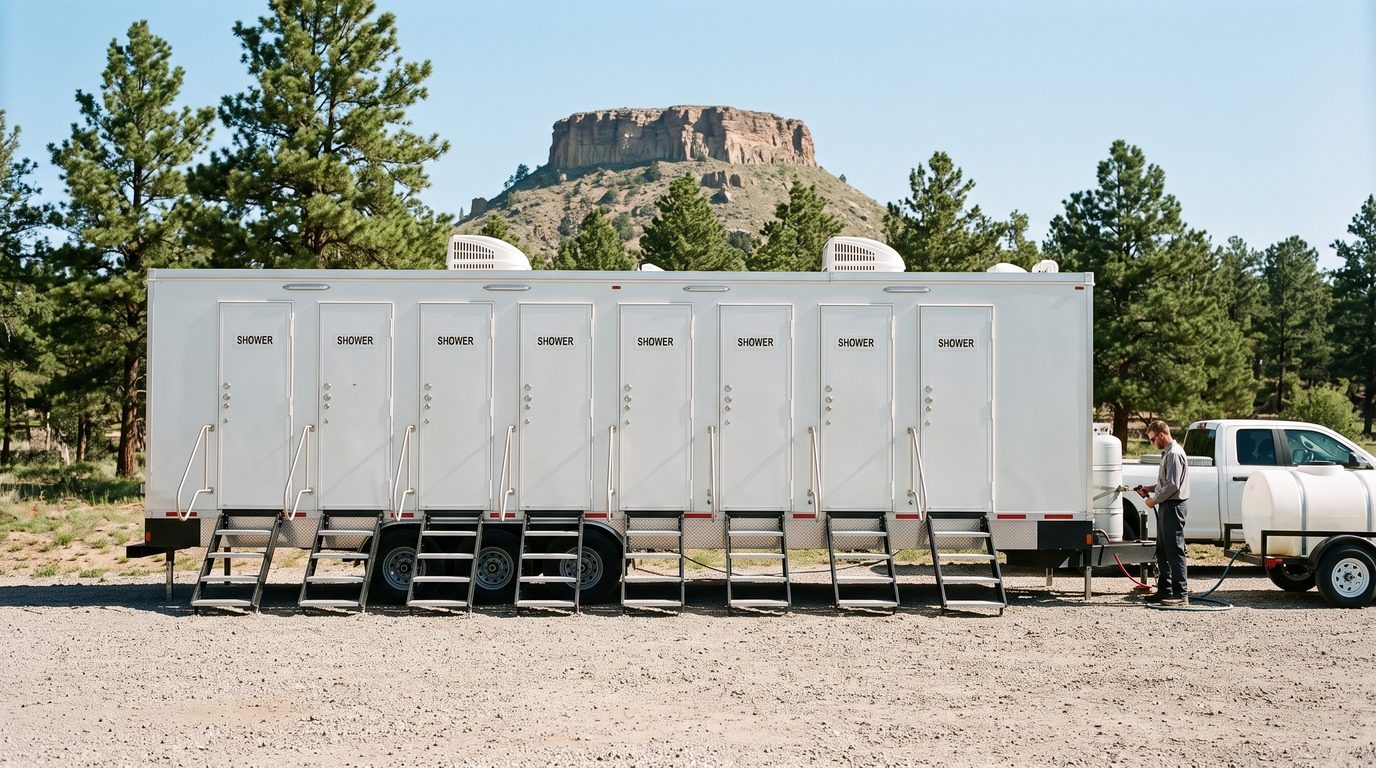
On delivery day the unit is set and leveled, connected to whatever the site has, filled or connected for water, and then tested stall by stall rather than switched on and declared working. The driver then walks the site contact through the unit before leaving, and on a typical Front Range job in Brighton that takes about ten minutes. It prevents most of what otherwise goes wrong.
Then the rhythm takes over. Service visits on the agreed cadence, revised once a real week of use has shown what the tanks and the usage actually do. Mid rental changes get handled by phone. At the end, the unit is drained, cleaned, disconnected and hauled out, the pad is left as we found it, and anything we learned about the site goes on the record so the next placement there starts further along than this one did.
JReachability
Who answers, and what they can decide
The number on this site reaches people who know the equipment and know where the units are. When a question comes up mid rental you get an answer rather than a ticket number, and the person giving it can usually act on it in the same call because they are the ones holding the schedule.
That matters most in the two situations where a delay is expensive. The first is an incident, where the work starts before the paperwork and the useful answer is which unit can roll and roughly when it lands. The second is a unit already on your site behaving oddly at an inconvenient hour, where ten minutes on the phone with somebody who knows the equipment frequently avoids a service call and always beats waiting until morning.
Remote sites need a different arrangement and we set one up rather than hoping. A pad with no cell signal cannot rely on a phone call to move a service visit, so those placements run on a plan agreed in advance with the windows written down, and any change gets made through whoever does have signal rather than through the person standing at the trailer.
Internally the same principle applies. When you call about a unit on a pad in Craig, the person answering reads the same site notes the driver wrote on delivery day, not a separate record that disagrees with them. That is why a mid rental change gets absorbed rather than triggering a round of internal clarification, and it is the main operational reason we stay narrow enough to keep everybody in one conversation.
KInsurance and licensing
Insurance and licensing for Colorado shower trailer rentals
We are licensed and insured, and we can supply certificates of insurance and vendor documents on request. Agencies, general contractors, event producers and facility managers each have their own vendor setup process, and we have worked through enough of them to know what is usually needed: a Form W-9, a certificate of insurance naming the right additional insured, a safety orientation, and sometimes a written service plan. Tell us early which forms your organization requires and we will have them ready before the first delivery rather than chase them afterward.
If your project has a formal vendor portal, send the link with your request. Completing it before delivery day is part of the job, not an extra.
Public work and incident work each add their own layer. An agency may want the service plan in writing before a purchase order exists, and an incident will run its own accountability rather than yours. Neither is a problem as long as it surfaces early, which is why the first call includes a question about what your side needs on paper.
LPaperwork order
Vendor paperwork for shower trailer rentals, step by step
Most paperwork holdups happen because the forms arrive in the wrong order, usually in the week of delivery. This is the order that works for the general contractors, agencies and event producers we deal with most, whether the job is a high rise in downtown Denver or a county fairgrounds out on the plains.
- 1. Vendor setup. A Form W-9 and your vendor registration, or the link to your portal. This is what lets your accounts payable team cut a purchase order at all, so it goes first.
- 2. Certificate of insurance. Tell us the certificate holder exactly as your contract spells it, plus anyone who has to be listed as additional insured. If the contract asks for a waiver of subrogation or primary and noncontributory wording, send us that clause and the certificate comes back with it.
- 3. Site safety. Orientation dates, badge rules and any drug testing or escort requirement for drivers. A driver who is not on the gate list at six in the morning is a delivery that slips a day.
- 4. Service plan. If your organization wants the service cadence in writing, we write it from the headcount and dates you gave us, then update it after the first real week of use.
- 5. Event permits. Larger gatherings usually file with the host county health agency about a month ahead. We supply the unit counts and service details that application asks for, and the permit itself stays with the event.
- 6. Closeout. Final invoice, pickup date and any lien waiver or closeout form your project uses. On a long placement these get lined up a week or two before the unit leaves.
Long placements add one more step. If a job runs past our policy renewal date, an updated certificate goes to you before the old one expires, so your compliance software never flags us halfway through the job.
Incident work is the exception to all of it. On a fire or a flood the unit rolls first and the agreement follows through the incident's own finance and logistics sections. That is normal, and it is nothing either side needs to apologize for.
MTrack record
Where our crews have set trailers
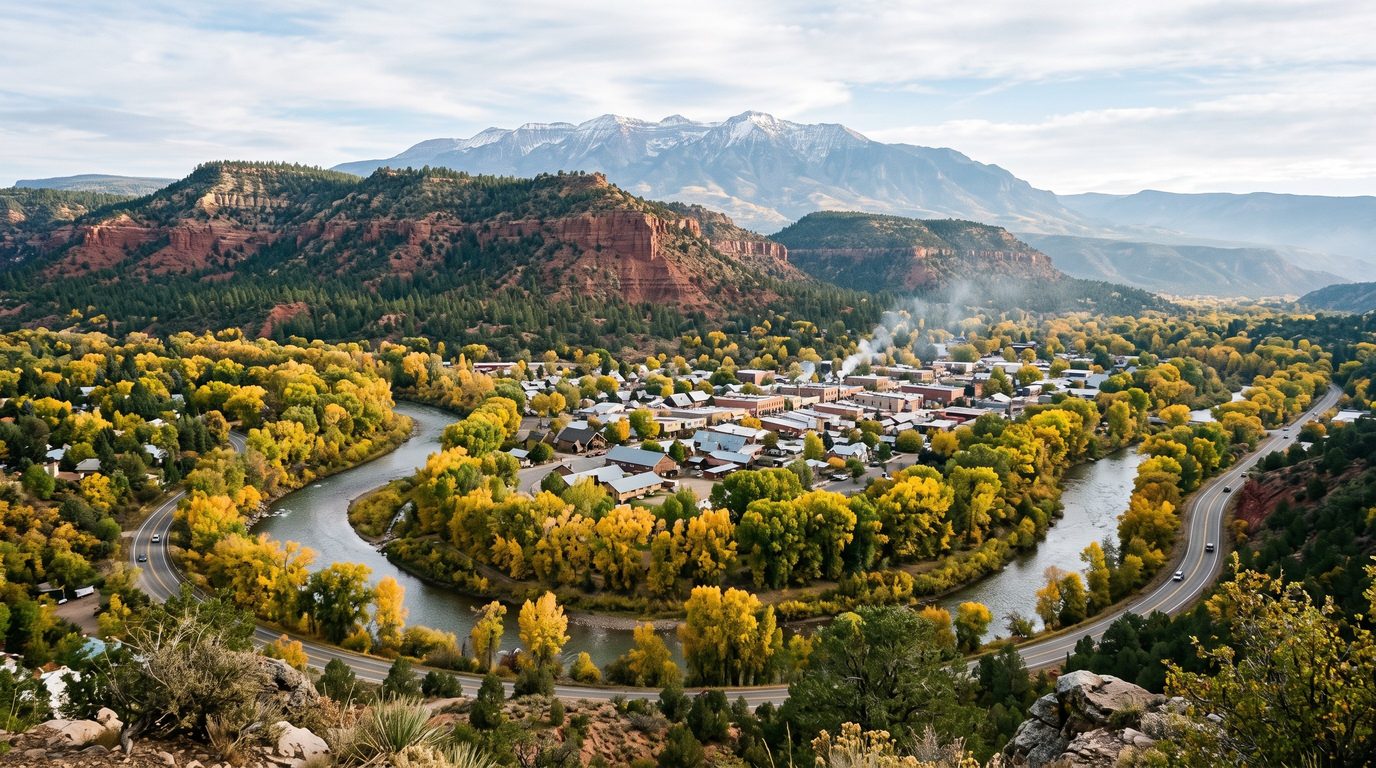
We work the whole state, but the places we have actually delivered to say more than a map. Our crews have set trailers in Denver and Englewood on the Front Range, in Colorado Springs under Pikes Peak, and up in Fort Collins. West of the divide we have run units to Grand Junction and Palisade in the Grand Valley, to Austin in Delta County, and down to Ridgway in the Uncompahgre valley. In the southwest corner we have delivered to Durango. In the central mountains we have set up in Buena Vista.
Those trips cover most of what Colorado throws at a delivery: interstate and metro traffic, a long haul over the Continental Divide, red rock desert on the Western Slope, mountain passes on the road to Durango and a river valley town where the last mile is the whole problem. If your site is somewhere else, it almost certainly looks like one of those, and we know how to plan for it.
What those runs teach is mostly about approaches rather than about towns. The gravel on a ranch road in the Uncompahgre valley behaves like the gravel on a lease road in the Grand Valley. A tight metro infill site in Englewood asks the same question as a tight staging yard anywhere else on the Front Range, which is where a service truck fits once the site fills with material. A high valley placement above Buena Vista and a high country placement anywhere else share the same generator arithmetic.
- Denver
- Englewood
- Colorado Springs
- Fort Collins
- Buena Vista
- Grand Junction
- Palisade
- Austin, Delta County
- Ridgway
- Durango
The list is where we have been rather than where we go. The whole state is the territory, and a town that is not on it only means we have not written about it yet.
NFirst contact
What to expect on a call with us
You will talk to a person who can quote and schedule, not a call center. We will ask where the site is, when you need the unit, how many people will use it and how they rotate, what the pad looks like, and whether water, power and sewer are available. From that we can usually tell you on the same call what we would put on the site and when it can be there.
If your dates are open, we will hold what we can while you confirm. If the job is urgent, say so and we will treat it that way. If you are quoting something nobody has won yet, say that too, because a bid quote is worth writing properly with its assumptions attached rather than pulling a figure off an old email.
Either way you get a straight answer, including the times when the honest answer is that a week is tight. A constraint you hear on Monday is worth considerably more than an agreement that collapses on Friday.
Call (866) 879-1053, or read about the equipment and where we deliver first.
CONext step
Put a Colorado crew in front of a hot shower
Send the site pin and the dates. We take it from there.
(866) 879-1053