
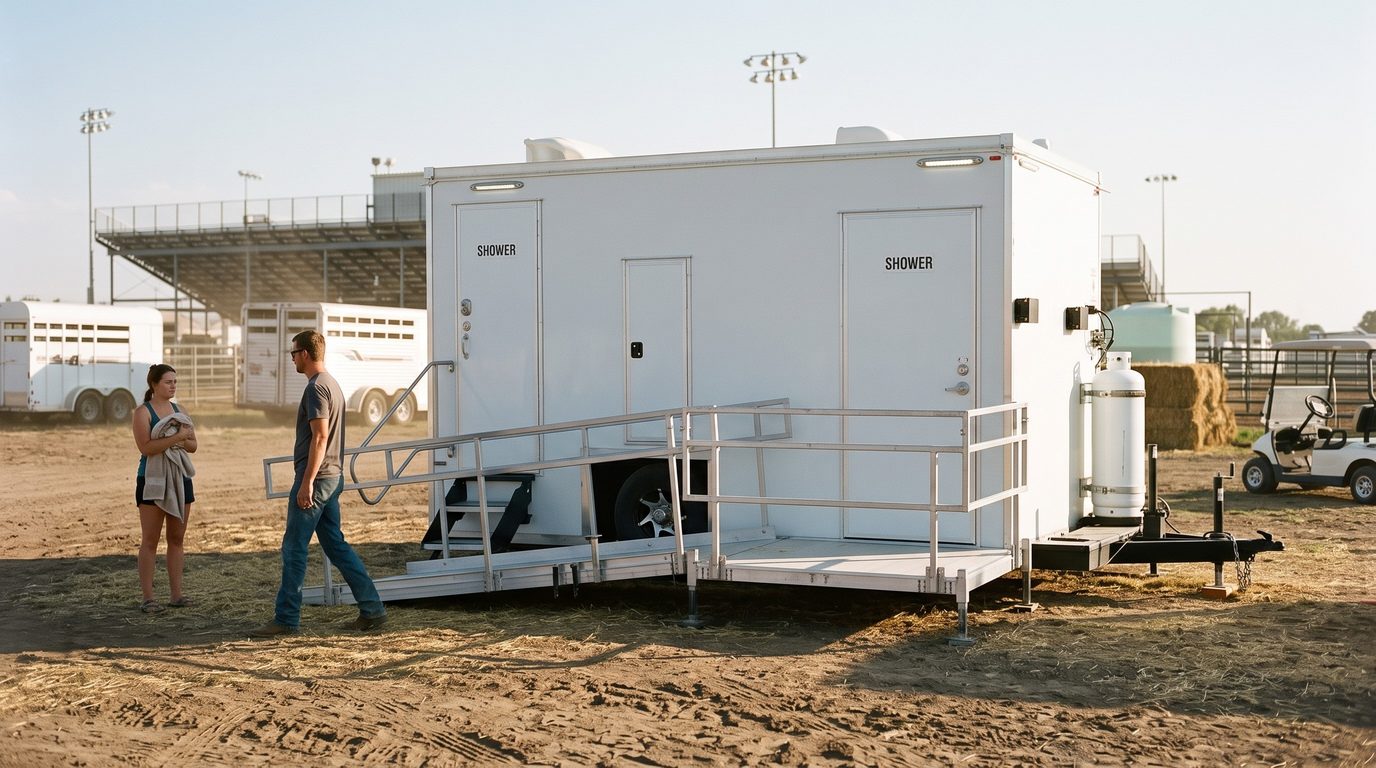
Colorado puts on a lot of events where people sleep on the grounds. County fairs and rodeos where families camp beside the livestock trailers. Music festivals in mountain valleys where the crowd arrives Thursday and does not leave until Monday. Endurance races, bike events, motorsport weekends, ranch rodeos, balloon festivals and town celebrations that have run for a century. All of them have the same quiet problem once the sun goes down, which is that a few hundred or a few thousand people have been outside all day in dust and heat and there is nowhere to get clean.
We have placed shower trailers at fairgrounds, hay fields, rodeo arenas and festival campgrounds all over the state. Here is what we have learned about making them work at an event.
Who actually uses the showers
Event producers usually think of showers as a perk for campers, and then discover the demand is broader than that. At a typical multi day event the users break down into a few groups, and they do not use the unit at the same times.
- Campers and attendees. Heaviest use, concentrated in the morning and again in the late afternoon before the evening program.
- Contestants and competitors. At a rodeo or a race, they want a shower right after they compete, which can be any hour.
- Stock handlers and barn crews. They start early, and nobody on the grounds gets more dirt on them.
- Staff, volunteers and production crew. Often on site days before the gates open and days after they close, and often forgotten in the planning.
- Performers and their crews. Small numbers, but the expectation is high and the placement is usually backstage and separate.
The practical result is that an event with fifteen hundred campers does not need showers for fifteen hundred people at once. It needs enough capacity to carry a morning peak and an evening peak, plus a separate quieter unit for the people who keep the event running.
Certificates of insurance on request.
Any town, quoted with a haul time.
Quotes and bookings on the call.
COEvent notes
Rodeo, fair and festival organizers on the showers
Rated 5 out of 5
Stock handlers and volunteers all wanted showers after the evening performance. Two trailers, and no line to speak of.
Rated 5 out of 5
They placed the unit where the pump truck could still reach it after the gates opened. First year that has worked for us.
Sizing without guessing
The honest way to size an event is to work from the schedule, not the headcount. We ask three questions: how many people are on the grounds overnight, what time does the main program start and end, and is there a hard gap where everyone is free at once.
An event with a 9 a.m. start creates a brutal morning peak between roughly 6:30 and 8:30. An event with an afternoon start spreads demand over four or five hours and needs far less equipment for the same crowd. A festival with late night programming shifts everything, and the peak lands in the early afternoon.
From there it is arithmetic. Average shower length at an event runs shorter than people expect once there is a visible line, and it runs longer when the unit is comfortable and nobody is waiting. Both are true and both matter. We would rather bring one more stall than run a queue that turns into a complaint on your event's social feed Sunday morning.
Two other things that reduce demand more than adding equipment does: posting shower hours by camp zone so the peak is staggered, and putting the unit where people can see whether there is a line without walking over to it.
Placement on a fairground or a festival field
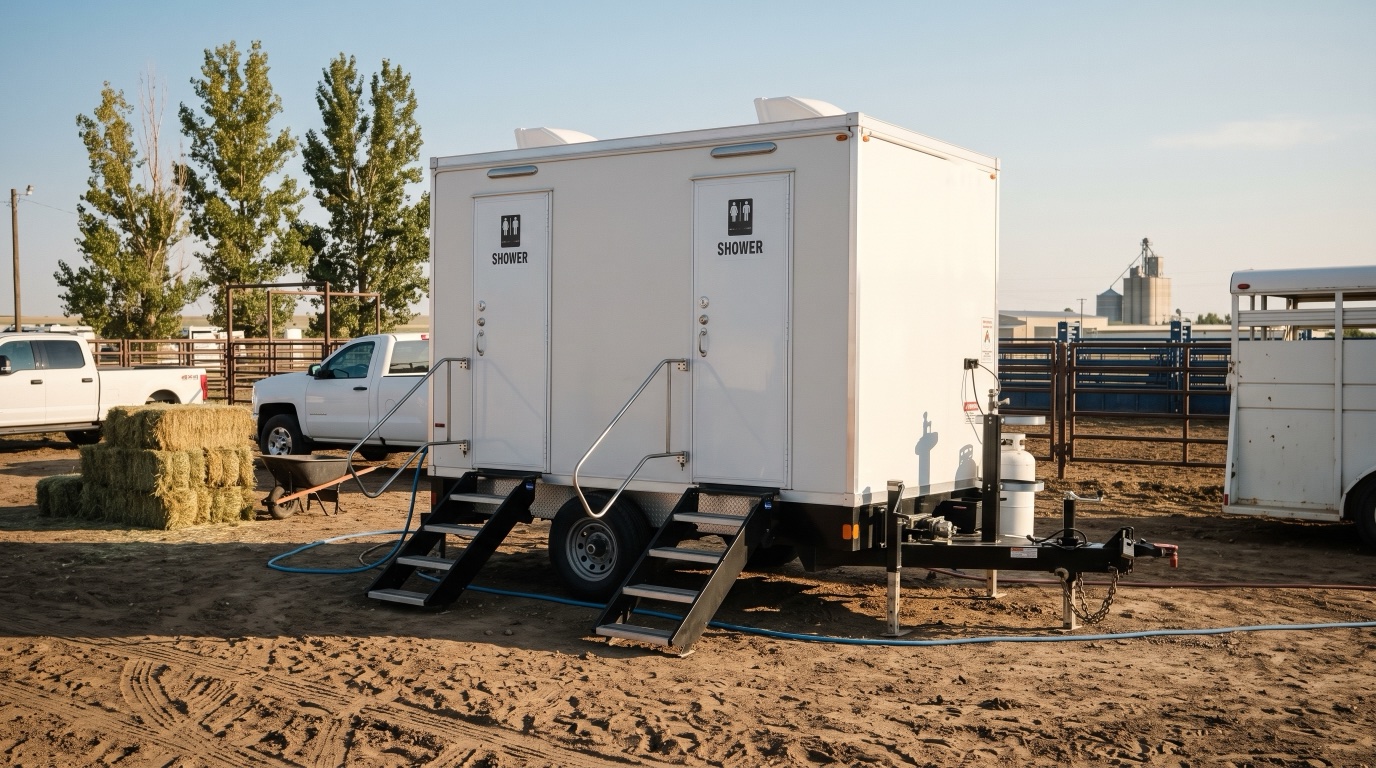
Placement decides whether the rental is a success. The requirements pull against each other, so somebody has to make the call early, ideally while walking the grounds with a site map in hand.
- Close to camping, not inside it. People will not walk fifteen minutes with a towel, but a unit set in the middle of tents runs pumps and doors all night next to somebody trying to sleep.
- Level, firm ground. Gravel, road base or packed dirt. Irrigated grass that looked fine Tuesday can be ruts by Saturday.
- Service vehicle access at all hours. The pump truck has to reach the unit after the crowd arrives and the roads fill with parked cars. Reserve the lane and cone it.
- Reasonable distance to water and power. Long hose and cord runs create trip hazards and pressure problems. Short runs keep the whole setup simpler.
- Light and sight lines. A unit in a dark corner behind a trailer feels unsafe and gets used less, especially by women traveling alone.
- A real accessible path. If an ADA unit is on site, the route to it has to be firm and passable, not a cut across a pasture.
- Drainage away from camping. Runoff, splash and foot traffic will turn the ten feet in front of the steps to mud. Mats and gravel fix it in advance.
Water, power and waste for a weekend
Fairgrounds in places like Grand Junction and Colorado Springs often have hydrants and service panels, which makes life easy. Private land, mountain meadows and ranch venues usually have nothing, and that is normal for us.
Where there are no utilities the plan is the same as any remote site: a potable water supply that is either bulk staged or hauled on a schedule, generator power sized for the unit and placed with the noise in mind, and waste pumped on a set cadence. On a busy weekend event the pump schedule is not optional and it is not once. We build it into the quote so nobody is negotiating with a vacuum truck at 6 p.m. Saturday.
Generator placement is worth an extra minute of thought. Put it downwind and behind something solid if you can, because the sound carries in a quiet field at 2 a.m. and the complaints will come to you, not to us.
Multi day servicing
A three day event with heavy use needs servicing during the event, not just before it. Our standard approach is a cleaning and restock pass in the late morning after the first peak, and again in the evening, with an attendant on site through the peaks for larger events.
The attendant is the upgrade most producers underrate. Somebody who keeps the stalls stocked, wipes down between heavy runs, watches the water level and calls the truck before it is a problem changes the guest experience completely. The showers stop being the thing people tolerate and become the thing they mention in a good way.
Rodeos and county fairs
Rodeo and fair grounds have their own rhythm. The barn crews are up before five. The contestants want a shower at ten at night after the last go. There is dust in everything, and the dust at a Colorado fairground in August is fine and gets everywhere, which means vanities and mirrors get used hard.
Fair boards also tend to have long standing habits about where vendors park and where the water comes from, and those habits are usually right because they came from decades of running the same grounds. We ask. The person who has managed that fairground for twenty years knows where the ground stays soft and which hydrant has pressure, and that conversation saves everyone a bad Saturday.
Mountain festivals and Colorado weather
A festival in a mountain valley near Ridgway or on the Western Slope can run eighty degrees at two in the afternoon and drop into the thirties by two in the morning, with a thunderstorm in between. That swing is exactly why climate controlled interiors and on demand hot water matter more at a Colorado event than they would somewhere flat and warm.
It also affects the schedule. Afternoon storms in July and August are close to reliable in the high country, and the hour after a storm clears is a demand spike because everybody who got soaked wants to warm up. Plan for it, and plan the power and hose runs so a downpour does not create a hazard.
Timeline and what we need from you
- Site map with your preferred placement and at least one alternate
- Overnight headcount, plus staff and crew counts that are often left out
- Daily schedule so we can find the real peaks
- Water source, power source, and whether waste service already exists
- Delivery window that lands before the grounds fill with parked vehicles
- Whether an ADA unit is needed and where the accessible route runs
- Who is on site for delivery, and who gets the call during the event
Book early for the summer months. June through September, every fairground, arena and festival field in Colorado is busy at once, and the units that handle a thousand person campground are not sitting idle in August. We would rather hold the right equipment for you in February than explain in July why the right equipment is somewhere near Durango for the weekend.