
Home/Rentals
COEquipment list
Private stall shower trailers with hot water, delivered anywhere in Colorado
What is inside every unit, how it runs on a pad with no hookups, and how we settle on the right size for your crew or your crowd.
Certificates of insurance on request.
Any town, quoted with a haul time.
Quotes and bookings on the call.
COUnit reviews
What renters say about the shower trailers themselves
Rated 5 out of 5
Eight stalls and the water stayed hot for a forty person crew coming off shift at once. Nobody waited more than a few minutes.
Rated 5 out of 5
The ADA unit had a real roll in shower and a bench, not a grab bar bolted into a standard stall. Our accessibility coordinator signed off on the spot.
Rated 5 out of 5
Nine degrees outside and the changing room was warm.
APrivacy
A locking door on every shower
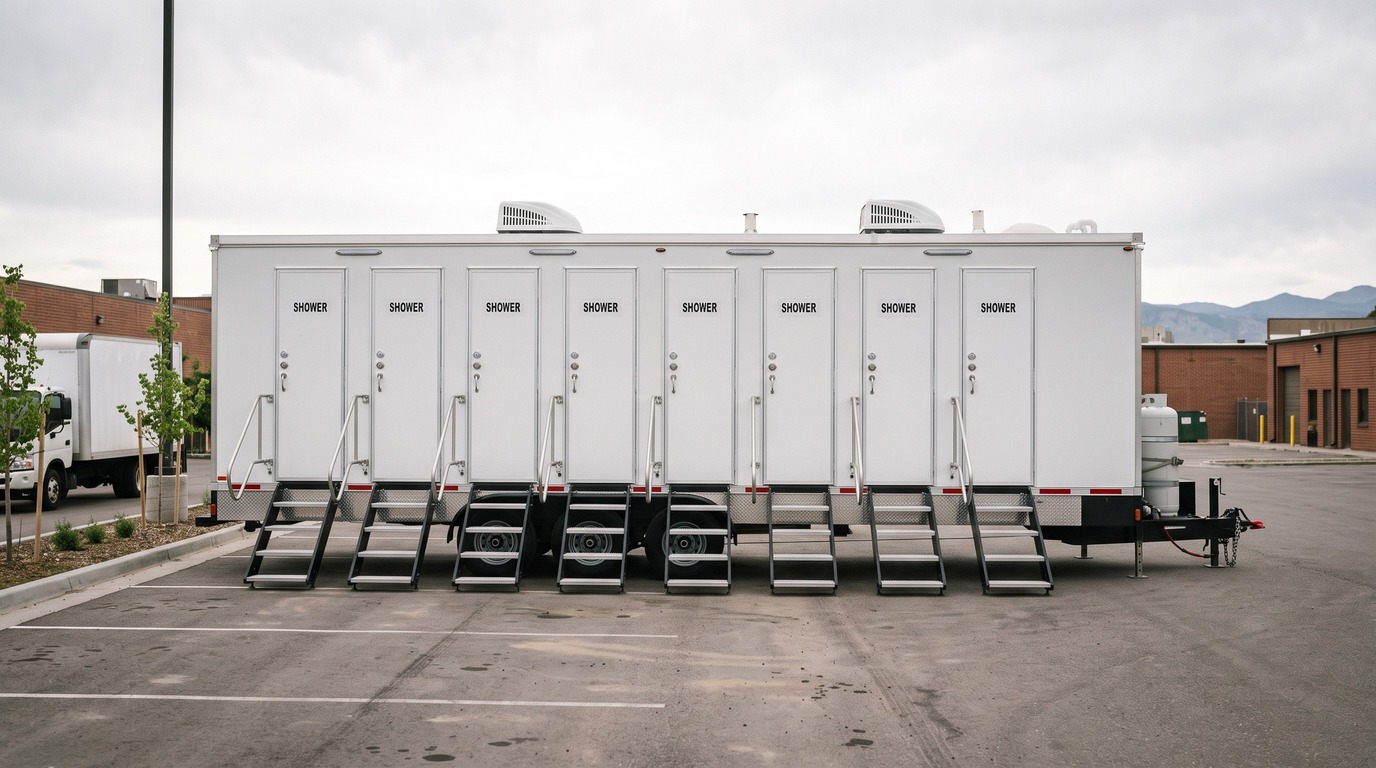
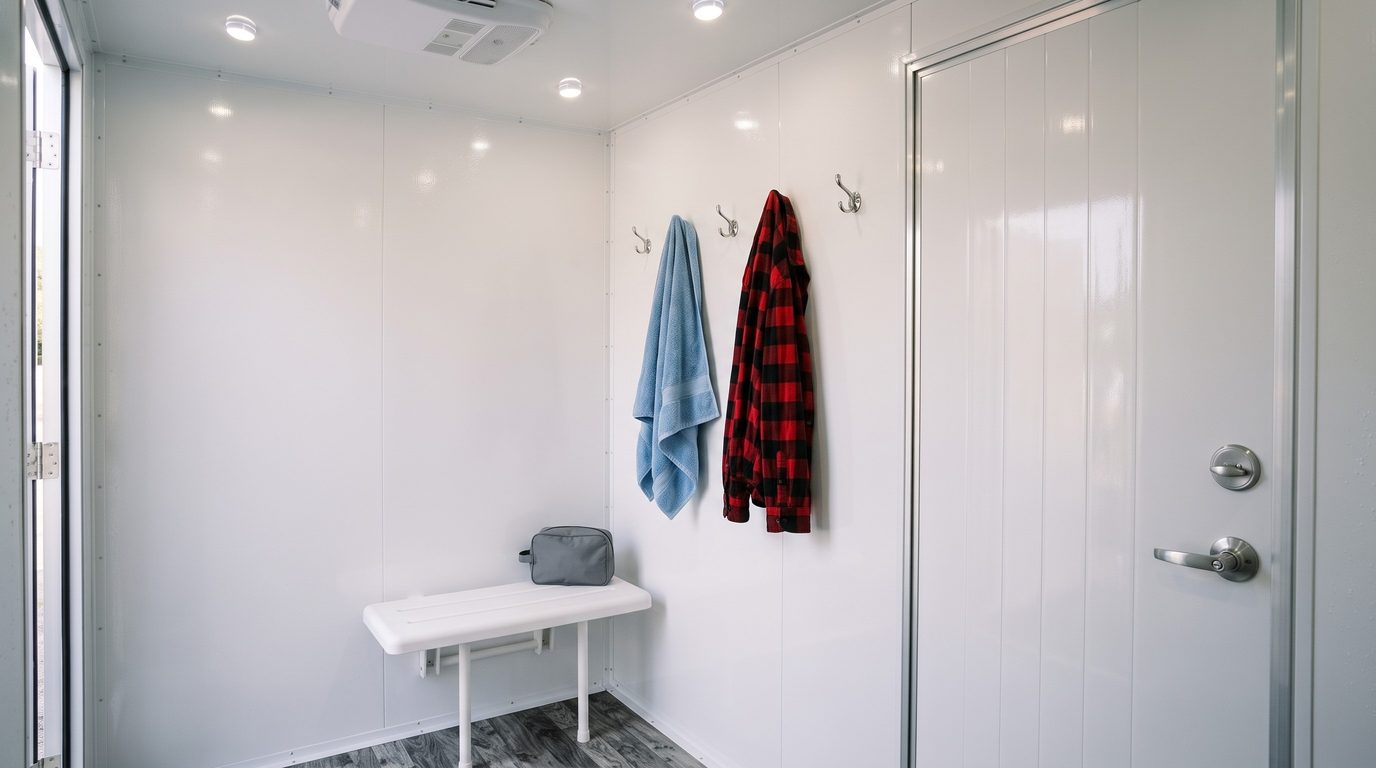
Each shower in the trailer is its own room. Solid walls, a door that locks from inside, a place to hang clothes and enough floor to change without your clean things touching a wet surface. Nobody is waiting in an open bay, and nobody is showering behind a curtain that blows open. On a job site that means people actually use the showers instead of skipping them. At an event it means guests, staff and performers can share the same unit without anyone feeling exposed.
Stalls open onto the outside of the trailer through individual doors with their own steps and hand rails, so traffic never crosses through somebody else's space. The doors and steps are built for daily use by work boots, not just weekend guests. Each entry has its own light, which matters more than it sounds like it should when the shift ends at five in the afternoon in December and the pad is gravel with no lights.
Privacy is also why these units get used at all. A crew that has to strip down in front of coworkers will skip the shower and drive home dirty, and a volunteer at a fairground will do the same. The design brief for the whole trailer is that somebody can walk up, lock a door behind them, and have the next eight minutes be their own. Everything else on this page is in service of that holding true on day forty of a job as much as the first.
There is a practical benefit to separate exterior doors beyond privacy. When one stall needs attention, the rest of the trailer keeps running. A fixture problem takes one door out of service instead of closing the unit, which on a long placement is the difference between an inconvenience and a crew with nowhere to wash.
CORenting
How renting one works
- Step 01
Start with the site
Where it is and when you need it, then how many people wash at the end of a shift. - Step 02
Get the quote
It names the unit and the service plan, with the assumptions written next to them. - Step 03
Paperwork and pad first
Vendor forms and insurance certificates cleared, and a firm spot the service truck can reach. - Step 04
Set, tested, serviced
The unit is leveled and tested stall by stall, then serviced on the agreed rhythm until pickup.
BConfigurations
Eight stall and ADA shower trailer configurations
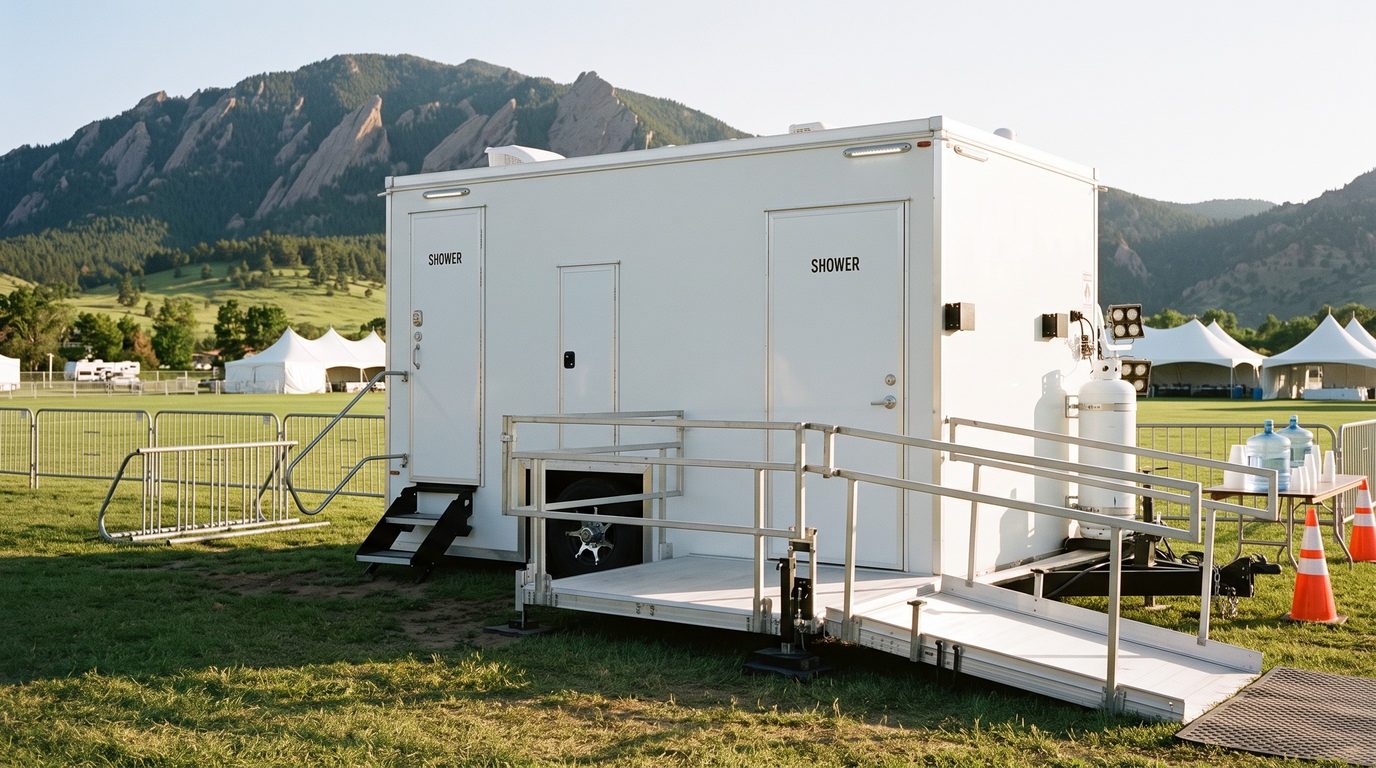
Two layouts cover almost everything we get asked for. The eight stall trailer is the main unit: eight private showers with their own doors, a vanity run with sinks and mirrors, and the mechanical bay that carries the heaters, pumps and tankage. It suits a working crew, a base camp, a fairground or any situation where a real number of people need to get clean inside a defined window.
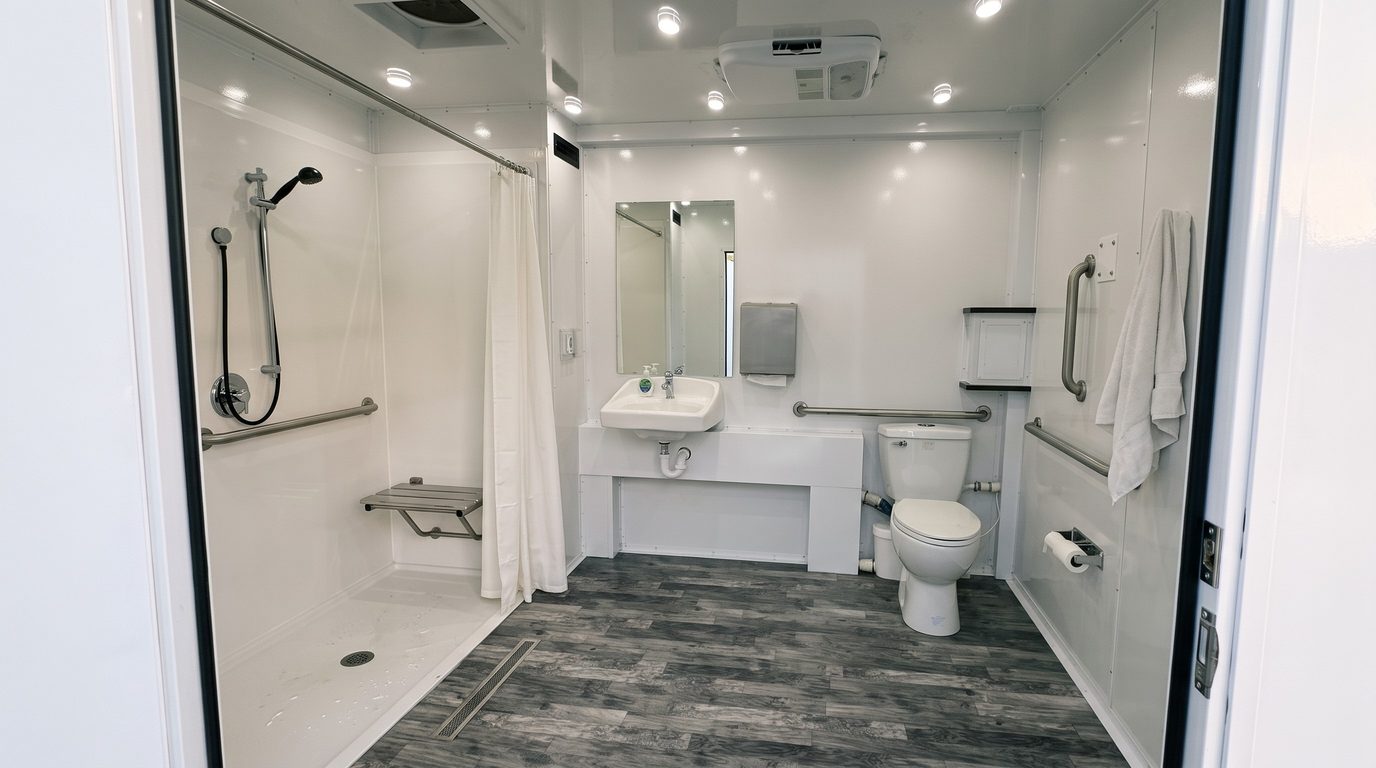
The second layout is an accessible stall plus two standard showers. It exists because an accessible shower is not a standard shower with a grab bar screwed to the wall. It needs a wider stall, a roll in entry with no lip to step over, turning space inside, a bench, fixtures and controls set within easy reach, and a ramp and landing outside. Building that properly costs interior room, which is why the unit carries three showers where the standard trailer carries eight.
Plenty of jobs take both. A public event that has to provide an accessible option will usually set an accessible unit alongside one or two eight stall trailers, and a long construction placement with a mixed crew often does the same. Multiple trailers on one site share a single service schedule, so a row of three is no more complicated to manage than a single unit once it is set.
What we will not do is tell you a layout fits when it does not. If the accessible approach on your site is a slope across loose gravel, the honest answer is that the pad needs work before the unit arrives, and we would rather say that on the first call than unload a ramp that nobody can use.
CSide by side
Comparing the eight stall and accessible shower trailer layouts
Most orders come down to one of the two layouts, or a mix of both. The table puts them next to each other so you can see which one carries your crew and which one your paperwork asks for. The hourly figures are planning numbers, worked from an eight minute shower plus a couple of minutes to change and dry off, not a promise about any one job.
| Eight stall trailer | Accessible stall plus two | |
|---|---|---|
| Private showers | Eight, each behind its own locking door | Three: one accessible stall and two standard stalls |
| Getting in | Separate exterior doors with steps and hand rails | Roll in entry with no lip off a ramp and level landing, steps for the two standard stalls |
| Inside the stall | A dry place to change and hooks to hang clothes | Wider floor, a bench, grab bars, turning space and controls within easy reach |
| Vanity side | Sinks, mirrors, counter space and lighting | The same vanity fittings as every unit |
| Showers in a busy hour | About forty | About fifteen |
| Pad it needs | Firm, reasonably level ground with room for a service truck | The same pad, plus a firm and level path from where people are to the ramp |
| Usual jobs | Crew placements, fire camps, fairgrounds and film base camps | Public events, agency and school work, and mixed crews that need an accessible option |
The water line is the one people skip. At two gallons a minute an eight minute shower uses about sixteen gallons, so forty showers come to roughly six hundred and forty gallons before anybody runs a sink. On a site with hauled water that figure decides the fill plan far more than the stall count does, and it is why we ask how many showers you expect before we ask which trailer you want.
Mixing the two is common and easy. On the state fairgrounds in Pueblo an order might put two eight stall trailers along the barns and one accessible unit near the stands, all running on one service schedule. On a construction job the accessible unit usually goes closest to the site office, where the approach is already graded and often paved, and the eight stall trailer sits nearer the laydown yard where the crew comes off shift.
If you are not sure which layout fits, give us two numbers and one answer. How many people come off shift together, how long the job runs, and whether anybody on the contract has asked for an accessible option. That settles it on the first call.
DWater heating
Hot water that does not run out at the fifteenth person
The water heaters are on demand, which means they heat water as it flows rather than filling a storage tank that goes lukewarm once a handful of people have been through. The practical effect is that the fifteenth person off a shift gets what the first one got. Storage tank systems are simpler and cheaper and they are fine at a house where four people shower across an hour. They are the wrong tool for a crew that hits the trailer together at the end of a shift.
Elevation changes the math. Burners draw combustion air, and there is less oxygen in a cubic foot of air at nine thousand feet than there is in the Grand Valley, so a heater set up for one is not correct for the other. We configure the heating for the elevation of the actual pad rather than the figure on its label, and we check the output once the unit is set and running on your site rather than assuming the bench setting survived the drive.
Incoming water temperature matters too, and in Colorado it swings hard. Water arriving from a hauled tank that has been sitting through a January night starts far colder than water off a summer hose bib, which means the heater is doing more work for the same delivered temperature. That is part of why we ask about the season and the water source in the same breath during the first call.
Flow at the shower head is deliberately modest. Most job site shower heads run in the range of one and a half to two and a half gallons a minute, which is enough for a proper wash and slow enough that the tank plan and the heater both keep up. A high flow head would feel better for two minutes and then empty the fresh water tank before half the crew had been through.
ESupply
Hauled in, or off a hose bib, and how much either takes
There are two ways water gets to the trailer. If the site has an approved potable connection, such as a hydrant with a water meter on a Denver Water main, the unit fills and tops off from that and the question goes away. If it does not, water is hauled in by tank truck or a tank on a trailer and transferred on site. Remote pads, high country venues and ranch headquarters normally plan on hauled water from the first day rather than discovering the need in the second week.
Planning volume is simple math, not a guess. Take the shower head flow, multiply by how long people actually stand under it, and multiply again by the number of showers you expect in a day. A short job site shower is a few minutes. Multiply that by a crew of thirty and the daily figure is substantial, which is why fresh water capacity and refill cadence drive real world capacity at least as much as the number of stalls does.
Two things reliably break the estimate. The first is shower length, because people take longer showers in winter when the trailer is the warmest place on the site. The second is a second use nobody mentioned, usually an evening group arriving on top of the daytime crew. Both are easy to plan for and both are expensive to discover on a Friday, so we ask about them up front and then check the real numbers against the estimate after the first few days of a long placement.
One thing that is never a water source is irrigation. Grand Valley agricultural sites frequently have a ditch running past the pad, and that water is not potable and does not go into a shower trailer under any circumstances. Same for stock water and untreated surface water. If the only water near the site is in a ditch, the plan is hauled water.
FHolding
Wastewater holding and licensed hauling on every shower trailer
Shower and sink water and, on units that carry toilets, toilet waste go into sealed holding tanks on board the trailer. Nothing is discharged on site. Not onto gravel, not into a ditch, not into a French drain somebody dug behind the unit. A licensed hauler pumps the tanks and takes the load to an approved treatment facility, normally with a manifest documenting where it went.
That approach steps around a regulatory question entirely. Colorado does have a framework for using graywater again on site, Regulation 86 on graywater control, and it is written for fixed buildings with treatment systems, underground irrigation and permitted discharge. A self contained trailer with sealed tankage is not that, and it does not need to be. Holding everything and hauling it out is how licensed sanitation companies work everywhere, and it is the only answer we give.
Pump out frequency is not a calendar rule. It falls out of tank capacity against actual use, which means headcount and how many showers run in a day. A small crew taking occasional showers can go several days between visits. A full crew showering every evening, or an event with a heavy peak, can need a pump every day or two. We set a starting cadence from the numbers you give us and then adjust it against what the tanks actually show in the first week.
Getting the cadence wrong in the tight direction is worse than it sounds, because a full gray tank stops the showers, not just the toilets. That is the single most common way a shower trailer fails on a job, and it is entirely preventable with a schedule set from real usage rather than a guess.
GElectrical load
What the trailer draws, and why altitude changes the generator
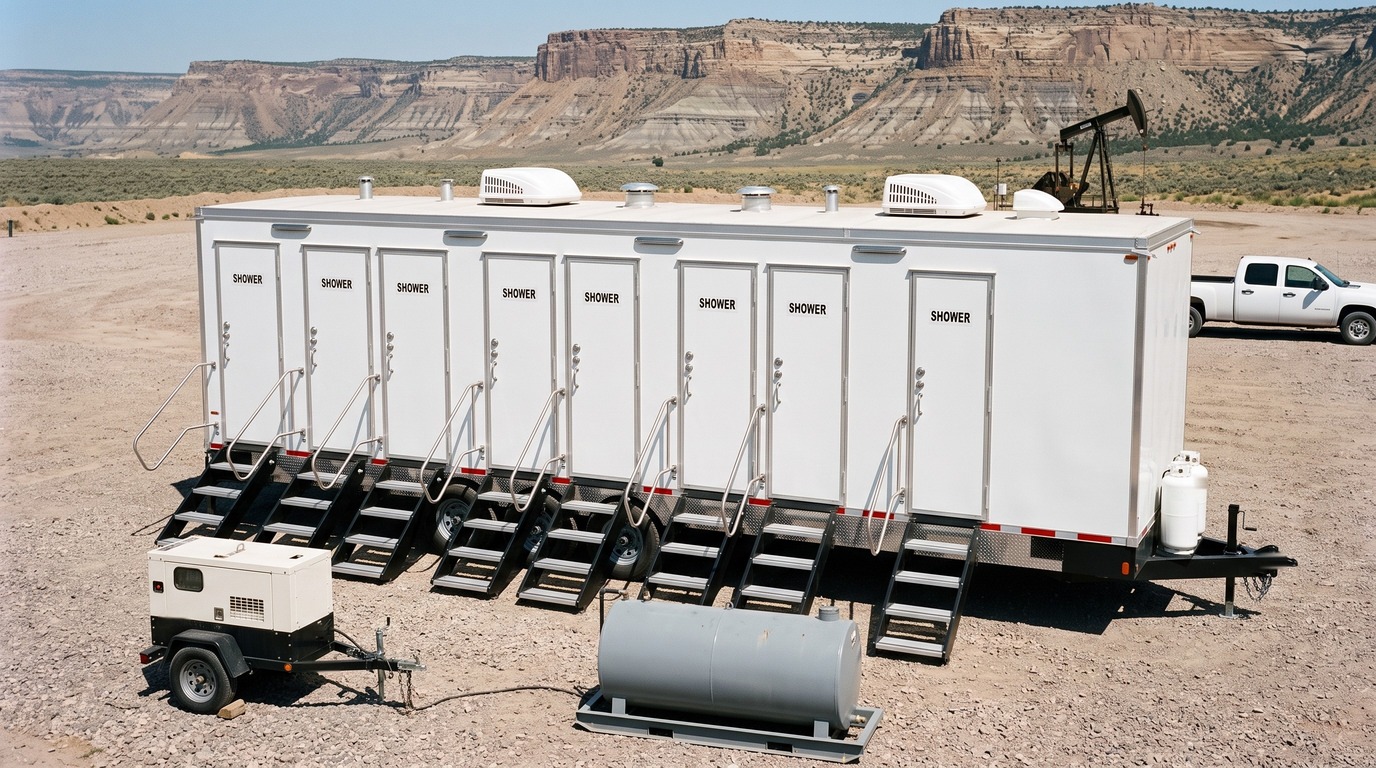
Draw depends on what is running at once. Water heaters, pumps, lighting and climate control all come on together during the shift change rush, which is exactly the moment the supply has to hold. Where a site has power we tie into it, and a standard site circuit keeps a long placement simple. Where it does not, the unit runs on a generator we size for the trailer and for the elevation of the pad.
Elevation is the part people miss. Combustion engines lose output as the air gets thin, and the industry rule of thumb is a loss of a few percent for every thousand feet of elevation gain. By the time a generator is working at mile high Denver it has already given up a meaningful slice of its sea level rating, and at a high country or high desert mesa site the gap is wider again. A generator chosen off the figure on its label can be genuinely too small on the pad, and the symptom is not a clean shutdown, it is heaters running weak and a crew asking why the water went cold.
So the sizing conversation starts with the elevation of the site rather than the specification of the trailer. We size with that loss built in, and if you are supplying the generator we will tell you plainly what it has to be able to do at your elevation rather than at the rental yard's.
Placement matters as much as capacity. A generator gets set where its noise and exhaust are away from the trailer doors and away from wherever people are sleeping, with the fuel plan and the refueling access worked out at the same time. On a camp that runs for weeks, a generator somebody has to squeeze behind a pile of material to fuel becomes a problem by the third week.
HInterior climate
Heat in the changing area, not just in the water
The interior of the trailer is heated and cooled. In winter that means a warm floor and a warm place to change, which is a different thing from hot water. Standing wet in a cold room ruins the shower, and on a high country site in January it is a genuine safety matter rather than a comfort one, the same cold stress risk NIOSH describes for anyone working outdoors. In summer on the plains it means the inside of a light colored box parked in direct sun stays usable through the afternoon.
Colorado makes this harder than most places because of the swing rather than the extreme. A high desert site can run hot enough at two in the afternoon that the cooling is working hard, and cold enough by four in the morning that the heat is. The interior system has to handle both inside the same twenty four hours, and it has to do it while the exterior temperature is still dropping.
Climate control also does double duty as plumbing protection. The heat that keeps a person comfortable is the same heat keeping the lines above freezing overnight, which is why the interior heat on a winter placement stays on continuously rather than being switched off when the last person leaves. The utility compartment is treated as heated space for the same reason.
IWinter build
Freeze protection built into every winter shower trailer
Cold arrives in an order, and things fail in that order. Exposed supply lines go first, then drain lines where water sits in a low spot, then tank contents, then whatever fitting nobody insulated because it was behind a panel. A winter build closes each of those off rather than the obvious one.
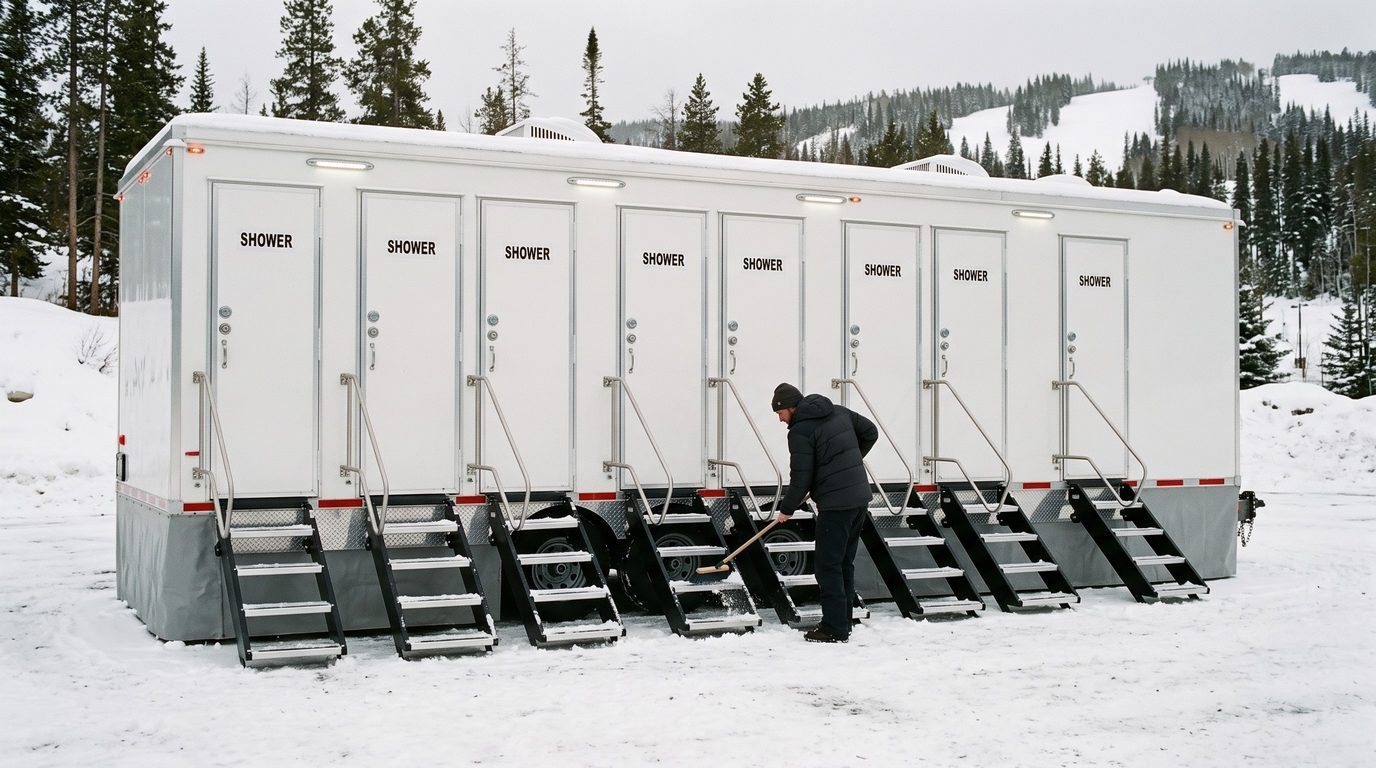
Every winter placement gets heat traced and insulated supply and waste lines, continuous interior heat, a heated plumbing bay and skirting where wind reaches the undercarriage. Tank heat is thermostatic and cycles on well above freezing rather than at it, so tank contents never approach ice point instead of being rescued after they get there. Your site contact gets the overnight routine in writing, because the routine is what actually keeps the unit alive.
The single most common winter failure has nothing to do with the equipment. It is a well meaning person shutting the generator down at the end of a shift to save fuel, which kills the interior heat, the tank heat and the heat trace all at once on the coldest night of the week. By morning the unit is a block of ice and the repair is measured in days. We walk the crew through that before we leave, and we say it more than once.
If a unit is going to sit unused with no heat, that is a different plan. It gets drained and blown out properly rather than left with water in it, and it gets put back in service when the site comes back. Half measures are what freeze. For the long version, read the winter entry on the reference desk.
JFixtures
The vanity side of the trailer
Each unit carries sinks with running water, mirrors, counter space and proper lighting. People shave, brush their teeth, wash up after a shift and get ready for the day at the vanity, and on some sites it is used harder than the showers themselves. A crew that has ten minutes before a briefing will use the sinks and skip the shower, and the trailer has to work for that just as well.
Lighting is bright enough to see by at five in the morning in December, which is not a trivial specification when the nearest other light on the site is a truck's lights. Counter space is real counter space, wide enough to set a kit bag down without it going in the sink. The finishes are what you would expect indoors rather than in a portable unit, which is why the same trailers work at a film base camp and a wedding as well as on a pipeline spread.
Handwashing with soap and running water is also the part of the sanitation picture with a regulatory hook on a construction site. Federal construction sanitation rules under OSHA 1926.51 require accessible toilets scaled to crew size and handwashing facilities with soap and running water where a water supply exists, and they are explicit that hand sanitizer on its own does not satisfy the requirement. A shower trailer goes well past that baseline, but the vanity run is the part that speaks directly to it.
KAccessibility
The accessible unit and what its approach needs
The accessible configuration carries a wider stall, a roll in entry with no lip, grab bars, a bench, turning space inside and fixtures set at ADA accessible heights, alongside two standard showers. Agencies, school districts, public events and a good share of larger contractors require one, and the requirement usually appears in the paperwork rather than in the first phone call, so it is worth raising early.
The approach is where accessible placements succeed or fail. The unit needs a firm, stable, level path from wherever people are to the door, and a level landing at the door itself, without steep grade breaks along the way. Packed gravel works. Loose gravel that a wheel sinks into does not. A path that crosses a drainage ditch does not, because the ditch is a grade break whatever it looks like in dry weather.
That makes site selection for the accessible unit more demanding than for a standard trailer, and it makes it worth settling before delivery day rather than after. We would rather walk the approach with your site contact on the phone in advance, or have somebody send photographs of the route, than arrive and find the only workable spot is across forty feet of soft ground.
Tell us early when an accessible unit is required, both so we can confirm one for your dates and so the approach gets planned with the rest of the pad. Moving an accessible unit after the fact is possible and it is nobody's favorite afternoon.
LCapacity
Sizing stall count to the crew shift pattern
Headcount on its own is the wrong number to plan from. What decides stall count is how many people want a shower inside the same window. A crew of forty coming off one shift together at six needs more stalls than a crew of forty drifting in across the evening, even though the census is identical and the total number of showers in the day is nearly the same.
So the question we ask is about the schedule. One shift ending together is a hard peak. Staggered shift changes smooth it out. An event with an early start has a brutal morning rush and then almost nothing. A camp with an evening briefing has a surge the moment it breaks. Each of those produces a different answer from the same headcount, and only one of them is the answer a stall count table would give you.
From the schedule we quote the number of stalls that carries the peak without a queue forming. Sometimes that is one trailer. Sometimes it is two or three set in a row sharing one service schedule. Occasionally it is fewer stalls than you asked for, because the peak is softer than it looks once the rotation is laid out, and we will tell you that rather than rent you capacity you will not use.
One more variable is worth naming: whether the same unit has to cover two different uses on the same site. A trailer serving a working crew during the day and a public event in the evening is a normal request and an easy yes, as long as both uses are planned together up front so tankage, water refills and pump timing are sized for the combination rather than for either half of it.
MOff grid
Most Colorado sites have no hookups waiting for you
Most of the Colorado sites we deliver to have no water, no sewer and no power. Fire camps, wellpads, ranch headquarters, festival meadows, remote construction staging, a right of way halfway down a transmission line. That is not an edge case we accommodate, it is the standard job, and the trailer is set up for it.
Off grid means three separate logistics chains running alongside the rental. Fresh water comes in on a schedule. Waste goes out on a schedule. Power runs from a generator with its own fuel plan. Each of those needs one person who owns it, and the single most useful thing a site contact can do is know which of the three is theirs and which are ours before the unit is set.
The other off grid problem is communication. Backcountry ranch land, deep gas patch country and high mountain venues frequently have no cell signal at the pad, which means service timing cannot depend on a phone call that nobody can make. Those sites get a fixed plan agreed in advance, with the service windows written down, and we work to the plan rather than to a text message that will not send.
Where a site does have hookups we use them, and the rental gets simpler. A hose bib removes the water hauling. A site power circuit removes the generator and its fuel. A sewer connection removes the pump schedule entirely. It is worth checking what is genuinely available rather than assuming, because a hydrant meter or a spare circuit on a nearby building changes the whole shape of a long placement.
NVisit rhythm
What a service visit actually covers
A rental is not a delivery, it is a delivery plus a rhythm. On every service visit the unit gets cleaned properly, stalls and vanity both, supplies get restocked, tanks get pumped if the schedule calls for it or if the levels say it should be, water gets topped up where we are carrying it, and the mechanical side gets checked rather than glanced at. Heaters, pumps, drains, door locks, lighting, heat trace in winter.
The point of checking the mechanical side on a clean visit is that the problems which strand a unit announce themselves early. A door that has started to bind, a drain that is slow, a heater that is cycling oddly, heat trace that has been knocked loose by somebody working under the trailer. Every one of those is a ten minute job on a Tuesday and a stranded unit on a Saturday night.
Cadence is set from headcount and duration and then revised once we have seen a real week. A long placement usually settles into a predictable pattern quickly. An event packs the whole cycle into a few days and may need service inside the run, which is a scheduling problem as much as a sanitation one, because a vacuum truck cannot drive through the middle of a crowd at seven in the evening.
Between visits, the number on this site reaches people who know the equipment and know where the units are. A heater behaving strangely at ten at night is worth a call at ten at night. We would much rather talk your site contact through something small than arrive in the morning to something large.
OFit
Which unit suits which job
Long construction and civil placements usually want stall count and a service cadence that runs itself. Highway, bridge and heavy civil crews often work in a right of way or a staging yard with nothing nearby, on a multi week or multi month schedule, and the priority is a unit that keeps working through weather with a schedule nobody has to chase.
Energy and remote industrial work is the same shape with harder access. Gas patch and mesa top sites mean hauled water, generator power, long pump runs and a route that a truck and trailer can actually make. Those jobs live or die on the logistics plan rather than on the trailer specification.
Events are the opposite problem. At the Pikes Peak or Bust Rodeo in Colorado Springs, the peak lands right after the evening performance, with thousands of people between the unit and any service truck. Placement matters more here than anywhere else, because a spot that works on load in day can be cut off once the grounds fill. Rodeos, fairgrounds, festivals and multi day races all run this way, and so does a supported tour that moves to a different town each night, where the trailer and its water and waste logistics travel with the event.
Incident and recovery work is its own category. Wildfire base camps run through an incident logistics section rather than a commercial booking, coordinating with the camp manager and fitting the facilities layout the incident sets. Flood and infrastructure recovery can mean a community whose water or wastewater system is offline, where the need is immediate and the site conditions are whatever the event left behind. Both are work we plan for rather than work we improvise.
If you are not sure which of those your job looks like, call (866) 879-1053 and describe the site. That conversation takes a few minutes and it is a better use of your time than reading a specification sheet.
CONext step
Name the site and we will name the unit
Headcount plus elevation is enough for us to name the unit.
(866) 879-1053